Want fewer ads?
Choose a DNS resolver that filters ad or tracking domains. Effectiveness depends on the DNS provider, the app and how ads are delivered.
TV DNS Switcher helps you set a chosen DNS resolver on your TV, phone or tablet without changing router settings. For regular users it is a simple Start / Stop switch. For advanced users it adds profiles, app groups, encrypted DNS, child profile mode and Expert DNS Tools for custom hosts and local rules.
The app does not promise magic. It gives you convenient DNS control. What gets limited or filtered depends on the DNS provider you choose and its filtering lists.
DNS helps apps and websites find the right internet address. Changing DNS may improve privacy, reduce some ad or tracking domains, use a family DNS mode or connect to your own resolver.
Choose a DNS resolver that filters ad or tracking domains. Effectiveness depends on the DNS provider, the app and how ads are delivered.
Choose a family DNS resolver that may restrict some adult or unwanted domains. It is helpful, but it does not replace parenting tools or conversation.
Enter custom DNS, DoH or DoT endpoints and use them on Android TV without configuring every app manually.
Set it once, press Start and use it. The TV interface is built for remote control, large buttons and clear focus states.
TV DNS Switcher uses Android's VpnService locally to route DNS requests to your selected resolver. It does not sell a remote VPN tunnel, does not promise location hiding and is not intended to bypass regional restrictions.
The app lets you choose DNS and manage configuration. It does not create its own blocking lists. Ads, trackers or family filtering depend on the selected DNS provider and its current rules.
Simple instructions for users who do not know DNS. In most cases you only pick a preset, approve Android's local VPN permission and press Start.
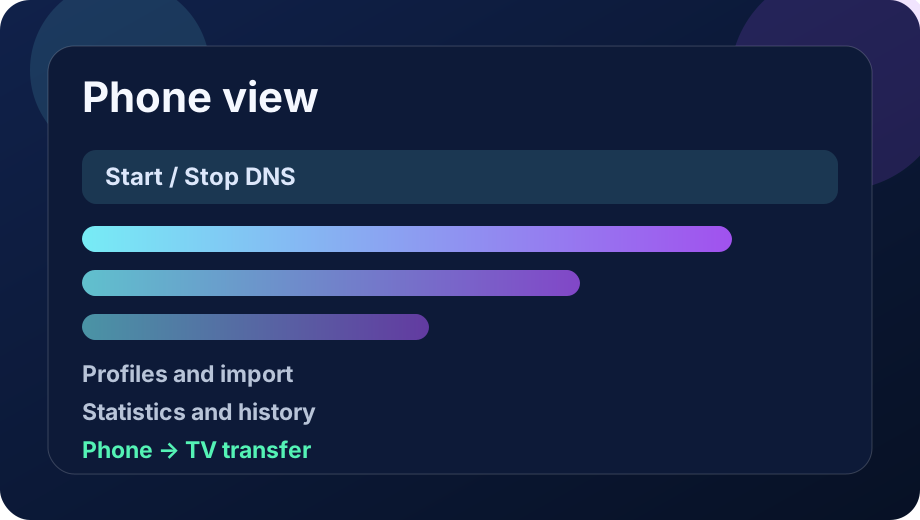
The Home screen shows DNS VPN status, active resolver, a large Start / Stop button and shortcuts to key sections.
Go to Servers and pick a preset such as AdGuard DNS, AdGuard Family, Cloudflare, Google DNS, Quad9, CleanBrowsing, OpenDNS, Control D or AlternateDNS.
You can enter DNS 1 and DNS 2. Classic DNS uses IP addresses, DoT uses a hostname, and DoH uses an HTTPS dns-query endpoint.
Android shows the standard VPN permission dialog. After approval, the app starts local DNS VPN and routes DNS requests through your selected resolver.
The Home screen shows whether the service is active. You can also see query count, responses, failures and the last diagnostic message.
In Apps, choose whether DNS should apply to all apps or only selected apps. You can filter the list and select visible apps.
A DNS profile saves the current DNS, mode and app selection. Later you can use, update, rename or delete it.
Export, import and QR transfer help copy configuration to another device without typing everything with a TV remote.
These three features make the app clearer. Profiles save DNS configuration, groups save sets of apps, and Child Profile protects selected settings with a parent exit code.
Saved DNS configurations.
Saved sets of apps.
DNS Profile answers: βwhich DNS and settings should I use?β. App Group answers: βwhich apps should this apply to?β.
Child Profile saves the current DNS and app selection. To change protected settings, the parent enters a 4-digit exit code.
First choose a DNS resolver, such as a family DNS, and select apps that should use the configuration.
The app asks for a new 4-digit exit code. This code is used to leave child profile mode.
In Settings you can set a separate 4-digit recovery PIN. Default is 0000 until the parent changes it.
If the exit code is forgotten, the parent can use the recovery PIN. This is still a soft in-app lock, not an Android system lock.
Expert Mode is optional. If you do not enable it, the app works as before. When enabled, DNS queries are checked locally by Custom Hosts and local rules before they are sent to your selected upstream DNS.
This toolkit is for people with a NAS, Home Assistant, a custom router, home lab or hand-made domain rules. Regular users can ignore it. Enthusiasts get features that are usually missing on Android TV.
nas.local β 192.168.1.10
*.tracker.com β Block
home.lan β Redirect 192.168.1.20
regex:^ads\..* β Block
/stats.json β local metrics
The main switch for advanced DNS features. When disabled, Custom Hosts, local rules and metrics do not affect normal app behavior.
PremiumManually map a name to an IP, for example nas.local to 192.168.1.10. The app can answer locally without asking external DNS.
Create rules such as *.tracker.com or, for experts, regex:.... You can block, allow or redirect domains.
Enter a domain and see which rule will match. The result shows Custom Hosts, Block, Allow, Redirect or upstream DNS.
PremiumCopy expert configuration to the clipboard and move it to another device. Useful when you manage multiple TVs or test rule sets.
PremiumAn optional local HTTP endpoint exposes DNS stats as JSON and metrics text. Enable it only on a trusted home network.
PremiumThis is the practical test path. Enable Expert Mode, add one simple rule, verify it with the domain test, then start DNS VPN.
Open Settings β Expert DNS Tools and enable Expert Mode. Without it, rules will not affect DNS traffic.
Add for example nas.local and IP 192.168.1.10. From now on this name can be handled locally.
Create *.tracker.com with action Block. For a redirect, choose Redirect and enter a target IP.
Enter for example ads.tracker.com. The app shows whether it matches wildcard, Custom Hosts, RegEx or upstream DNS.
Return Home and press Start. Real DNS requests now pass through the local rule layer.
Enable LAN Metrics. From a browser on the same network, open http://<TV-IP>:8765/stats.json.
example.com β exact domain.*.example.com β subdomains such as a.example.com.regex:^ads\..* β RegEx for users who know what they are doing.Add nas.local β 192.168.1.10. Apps and browsers can use a friendly local name without running a separate DNS server.
Select a family DNS, add local rules for chosen domains and save it as Child Profile. Parent code protects settings from accidental changes.
Add a few wildcards, use domain test and check whether the rule is too broad. This is safer than guessing after the service is started.
Enable LAN Metrics and read /stats.json or /metrics from your own panel. This is for users who monitor their home network.
Free stays simple. Premium Lifetime adds tools for users who want more DNS control on Android TV.
Starts or stops the local DNS VPN. On first start, Android may ask for VPN permission.
FreeReady-made DNS servers: AdGuard DNS, AdGuard Family, Cloudflare, Google DNS, Quad9, CleanBrowsing, OpenDNS, Control D and AlternateDNS.
FreeEnter DNS 1 and DNS 2. Useful if you have your own resolver, a company DNS or a provider not listed in presets.
FreeThe Home screen shows service status, active DNS, requests, responses, errors and recent events.
FreeFull saved configurations: use, update, rename or delete. Perfect for modes like Home, Kids, Testing or Streaming.
PremiumSaved sets of apps. Quickly choose which apps should use DNS VPN without selecting the list from scratch.
PremiumSaves DNS and apps, then requires a 4-digit exit code before protected settings can be changed. It includes a separate recovery PIN.
PremiumDNS-over-HTTPS and DNS-over-TLS are encrypted DNS modes. The app includes presets and custom endpoints.
PremiumMove configuration between devices without typing everything with a remote. Useful when you manage multiple TVs.
PremiumAfter Android TV boots, the app can reconnect DNS VPN using current settings or a selected profile.
PremiumCheck whether DNS responds correctly. Logs can be copied or exported for support.
PremiumOptions for difficult networks plus an assistant that guides users to Android Always-on VPN when stronger protection is needed.
PremiumFree is for quick DNS switching. Premium is for profiles, selected apps, child profile mode and Expert DNS Tools for advanced users.
Simple DNS switching for the whole device.
One-time unlock through Google Play. The final price appears in the store.
DNS/VPN apps require trust. That is why the page clearly says that TV DNS Switcher creates a local VPN service only so Android can route DNS requests through the resolver selected by the user.
The app does not require an account. Premium purchase is handled by Google Play Billing. The website does not add ad trackers.
Privacy policy, terms and support are available from every language version of the website.
No. It is a DNS tool based on Android's local VpnService. It does not provide a remote tunnel, does not change your country and does not promise location hiding.
No honest DNS app should promise that. TV DNS Switcher lets you choose DNS. Some DNS services can block part of ad or tracking domains, but effectiveness depends on the DNS provider, app and network.
You can choose a family DNS resolver that tries to filter such categories. It is a helpful setting, but it does not guarantee full protection and does not replace system parental controls or conversation.
A DNS Profile saves DNS configuration and behavior. An App Group saves selected apps. Profile means βwhich DNS should I useβ, group means βwhich apps should it apply toβ.
Open DNS Profiles. Next to a saved profile, choose Use, Update, Rename or Delete. Update replaces the profile with the current DNS and app selection.
Open App Groups and choose Edit. The group loads into Apps. Change selected apps, then press Save app group.
The parent first chooses DNS and apps, then creates Child Profile and sets a 4-digit exit code. While the profile is active, changing protected settings requires the code.
It is a separate 4-digit PIN configured in Settings. It is not the child profile exit code. It resets the active lock if the exit code is forgotten. Default is 0000 until the parent changes it.
No. It is a soft in-app lock. It does not lock Android, take over the device or prevent access to system settings.
Premium Lifetime unlocks DNS Profiles, App Groups, Child Profile, app selection, DoH/DoT, QR/import/export, autostart, diagnostics, IPv6, TCP fallback, Kill Switch Assist and Expert DNS Tools.
It is a section for advanced users. It adds local DNS records, custom wildcard/RegEx rules, redirects, domain testing, rule import/export and local LAN metrics.
For domains added in the app, practically yes. If a domain matches a local record, the app returns the configured IP without asking external DNS. It does not replace a full DNS server for the whole network.
They should not be exposed outside your home network. It is a local HTTP endpoint for trusted LAN use. Enable it only when you know who can access your network.
Choose DNS, save profiles, create app groups and use Child Profile when you want to protect settings from accidental changes.